Japanese cuisine offers a great variety of dishes and regional specialties. Some of the most popular Japanese dishes are listed below.
Sushi
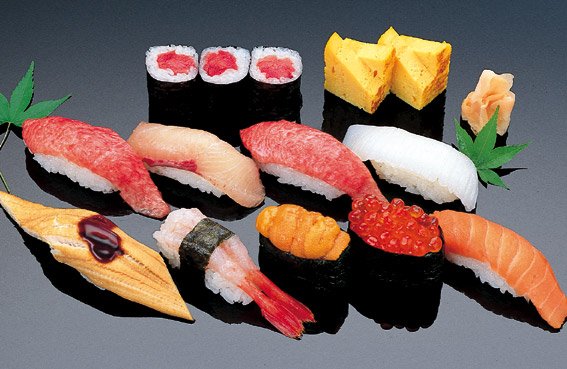
Sushi can be defined as a dish which contains sushi rice, cooked rice that is prepared with sushi vinegar. There are various kinds of sushi dishes.
Tempura
Tempura is seafood, vegetables, mushrooms and other pieces of food coated with tempura batter and deep fried. Tempura was introduced to Japan by the Portuguese in the 16th century, but has become one of Japan's most famous dishes internationally.
Domburi
A bowl of cooked rice with some other food put on top of the rice. Some of the most popular toppings are tempura (tendon), egg and chicken (oyakodon), tonkatsu (katsudon) and beef (gyudon).
Sashimi
Sashimi is raw seafood. A large number of fish can be enjoyed raw if they are fresh and prepared correctly. Most types of sashimi are enjoyed with soy sauce and Japanese horseradish (wasabi).
Ramen
Ramen is Chinese style noodles prepared in a soup with various toppings. Ramen is one of the many popular dishes that were originally introduced from China but have become completely Japanized over time
Finally the drink, sake is the most popular drinks in Japan. It is a Japanese alcoholic beverage made from rice, which sometimes is also called rice wine, but in truth, it is not a wine, nor is it exactly a beer, nor a spirit. Sake is a rather unique type of fermented alcohol.
Here is an interesting clip on how to eat sushi properly:
Japanese:
How To Eat Sushi
Showing posts with label origin of sushi. Show all posts
Monday, April 19, 2010
Japan: FOOD!
Labels:
domburi,
japan,
japanese cuisine,
origin of sushi,
ramen,
sake,
sashimi,
tempura
Tuesday, April 6, 2010
Japan: The Origin and "how to" of SUSHI!
We are BIG fans of food around here so every time we explore a new country, the cuisine is one of our favorite topics. (if not THE favorite topic.) Exploring Japan this month, naturally we thought of sushi.
The origin of sushi dates back many decades when fermented rice was wrapped around raw fish as a technique of preservation. It was called nare-sushi. Eventually the Japanese acquired a taste for the raw fish/rice cuisine and calling it seisei-sushi, this technique of preservation eventually became a cuisine.
During the Edo Era between the 1600’s and the 1860’s haya-sushi became what is popular today; raw or partially raw fish wrapped in rice and seaweed accompanied by vegetables and vinegar. Many modern sushi restaurants serve these “sushi rolls” today.
In the 19th century, when Japan was still calling its era the Edo Era, a new form of sushi was developed named nigiri-sushi. This is the most common type of sushi in restaurants as it is a mound of rice topped with a piece of fish.
How to make a sushi roll:
*It is important to remember that consuming raw or undercooked meat, poultry, seafood, shellfish and eggs may increase the risk of food borne related illness. Fresh fish should be frozen at under -4 degrees Fahrenheit for a significant time in order to kill all the parasites.
1. Place nori (seaweed) on a bamboo mat with the shiny side down.
2. Spread pre-cooked rice thinly on the nori, thinly enough to see nori underneath.
a. Leave half an inch space on nori (furthest end from you) to dab warm water on; this will help hold the roll together.
3. Place all ingredients (fish, vegetables, etc) in the middle of the roll.
4. Start to roll the sushi away from you with the bamboo mat until it comes together.
a. It is recommended to push the rolled up sushi bundle with medium pressure to tighten the roll and combine ingredients.
5. Cut the log in the middle and each half into sections.
6. Enjoy!
For more detailed information on how to properly cook the rice and on how to make sushi, visit the following website http://www.mahalo.com/how-to-make-sushi.
Subscribe to:
Posts (Atom)