.:[Double Click To][Close]:.
Showing posts with label climbing safety. Show all posts

Friday, April 23, 2010

Japan: Staying Safe

When traveling to any foreign country it is imperative to practice all safety precautions and know how to react in the case of an emergency. What happens if you or one of your family members were injured? Would it be a nightmare getting proper care? E.g. What if you slipped on Fuji-san? These are all great questions!

Never go to Japan (or anywhere for that matter) without adequate health insurance. You will not get help without it. If you’re really concerned, particularly with things like climbing Fuji, it’s sometimes better to get a tour, for the peace of mind aspect of knowing you will have help on hand if needed. In case of an emergency, it's best to have a Japanese-speaking person call the emergency services in Japan. If that's not an option, call the Tokyo English Lifeline (TELL) at (03) 3403-7106 for emergency assistance in English.

Climber on Mt.Fuji

Also, depending on when you travel; Japan’s summer heat and high humidity can lead to possible food poisoning, fatigue and heat stroke. In spring and fall, many people suffer from rhinitis and itchy eyes caused by pollen, especially to Japanese cedar pollen. A small medical kit can save you the problem of running around and looking for items that are a lot easier to find at home.

Hygiene standards are high in Japan, and medical facilities (although expensive) are widely available. So, the most important preventive measure is to make sure that you are healthy BEFORE you start traveling!

Friday, January 22, 2010

New Zealand: Staying Safe on Your Adventures

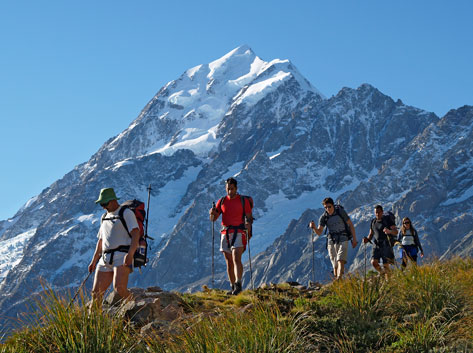
New Zealand is a relatively safe travel destination. However, when it comes to your safety, it's important to take the same care in New Zealand as in your own country. One thing that all travelers want to do in New Zealand is walk- through forests, up mountains, along riverbanks and around lakes. It’s the easiest way to get into the landscape. The necessary safety precautions are vital in ensuring a worry-free and fun expedition.


Weather conditions in New Zealand alpine areas can change rapidly. Be prepared for cold wet weather if you plan to walk in the National Parks, whatever the time of year.

In wetter areas, particularly in Fiordland, sand flies can be pests, but are effectively controlled by use of an insect repellent.

Giardia is a water-borne parasite that causes diarrhea. To avoid contracting it, it is best not to drink water from lakes, ponds or rivers without first boiling, chemically treating or filtering it.

New Zealand's clear, unpolluted atmosphere and relatively low latitudes produce sunlight stronger than much of Europe or North America, so be prepared to wear hats and sun block if you plan to be out in the sun for more than 15-20 minutes.

Although no vaccinations are required to enter New Zealand, it's a good idea to pack a basic first-aid kit for your trip, particularly if you plan to go hiking, camping or to remote parts of the New Zealand.

Tuesday, June 2, 2009

South Africa: World Cup!


For all you soccer fans out there, you probably already know that South Africa won the bid to host the 2010 World Cup, but for those of you who didn't know, please allow me the pleasure of sharing the news!

For South Africa, hosting the World Cup has been a 20-year journey from the end of apartheid, the government-sanctioned policy of racial separation, and the release from prison of Nelson Mandela, to the World Cup. In between, South Africa’s unsuccessful bid to host the 2006 World Cup, which went to Germany in a close vote. South Africa persisted, and was awarded the tournament in 2004 when the president of FIFA, Joseph S. Blatter, committed soccer’s worldwide governing body to taking its major men’s championships to the African continent.

Still some are skeptical on two counts: Can South Africa develop the infrastructure and man power to pull off such a feat, and is South Africa safe enough for an international tournament?

Since winning the bid, significant progress has been made on the 10 stadiums in nine cities that will be used for the World Cup. All stadiums are due to be finished by the end of 2009 or earlier. South Africa’s recent pedigree of hosting other major sporting events is impressive as well. Those include the World Cups of rugby, cricket, and track and field. In recent months, the country also played host to the entire season of the Indian Premier League of cricket.

SA believes they have a security plan in place and the World Cup will be played without incident.

Congratulations to South Africa for winning the bid to host the 2010 World Cup!

What do you think are the biggest safety concerns for the players and spectators at the games?

Tuesday, May 26, 2009

Mexico: Take Care While Adventuring


There is plenty of adventure to be had in Mexico.

About an hour northwest of Monterrey, a craggy limestone outcrop named El Potrero Chico has been quietly attracting rock climbers from around the world. What makes the area unusual is the sheer variety of the 600-plus bolted routes — in which permanent artificial anchors are embedded in the rock — all within easy access of a campground and lodge at the base of the rock. Read more about El Potrero Chico.

If you are trained in climbing (and I don't recommend this climb if you are not) then you know how important it is to be safe while climbing. A single wrong move or slip can be the difference between a great day and a REALLY bad day! As you know, when you participate in any activity outdoors, you should be prepared with a few things at all times: sunscreen, insect repellent, first aid kit, drinking water, just to name a few. Have a safe climb.

If its not so much heights as it is depths that excites the adventurer within you then Mexico will not disappoint. Forty miles northwest of the party port of CancĂșn is little-known Isla Holbox (pronounced OLE-bosh), a narrow spit of white sand some 25 miles long and no more than two miles wide at its widest point, situated in the Gulf of Mexico. From June through September, the island’s offshore waters are the site of a large congregation of whale sharks, who come here to feed on seasonal plankton blooms. More on Isla Holbox.

If you come into contact with coral reefs while snorkeling there are a few safety tips to keep in mind.
  • Coral is an animal that makes calcified outer skeletons which make sharp, jagged edges, so to prevent injury, avoid standing on reefs.
  • Wearing reef shoes, gloves and a wet suit will better protect you.
  • If injured, promptly scrub the coral cuts with soap and water and flush with copious amounts of water to remove any coral fragments.
  • Rinsing with vinegar or rubbing alcohol may help relieve stinging.
  • Seek medical attention immediately if the cut is large enough to require stitches.
You should make sure that your tetanus vaccination is up to date and it would be helpful to carry a wound care kit with you to help prevent infection.